"There are some who can live without wild things and some who cannot." - Aldo Leopold
Showing posts with label florida alligator hunting. Show all posts

Wednesday, October 2, 2013

The Baited Gator

DSC_1848edited
(Also Published at Good Hunt)

I bet Nick and Trace each $1 that the gator cruising up to the baits would choose the meaty sirloin over the bleached-white rotting chicken that looked like something that floated off the carcass of a bloated whale.
I lost 2 bucks. Shows what I know – but, hey, this was my first experience baiting gators.
The gator grabbed the chicken in his jaws, chomped a couple times and took the chunk of flesh down his gullet.
Baiting is a popular method in which to entice a gator close enough to get it attached to a restraining line. No hooks are permitted by law, as the FWC stipulates:
Baited wooden pegs less than two (2) inches in length have been used as a legal and effective method for attaching a restraining line to take an alligator. A baited wooden peg is attached to a restraining line that is hand-held or used with a fishing rod and reel and high-test line. The baited peg is typically thrown or cast near the alligator or near the area where it last submerged. The line of a baited wooden peg cannot be terminated with a float. The end of the line must be attached to the boat or hand-held.
Baits include rotten chicken, beef or beef lung, all of which will turn a stomach in a heartbeat. In some instances, the leader is wrapped around and through a bait and cleated off to the peg. Some folks fill the baits with spray foam to help it float. The baits are then left in buckets to stew for a few days before the hunt to create the putrid scent that’s attractive to the reptiles. Once the gator ingests the bait, the fight is on, though care must be taken to not pull it out or force the gator to regurgitate it.
That monster, national news-making gator Harris and Matt killed a few weeks back took the beef option. The first time he bit, the gator spit the bait after pressure was applied. When he returned, though, he did so with a vengeance, rolling the steak across his back before sucking it down. From what they tell me, it was quite a show.
So I was excited to see it for myself. With a successful season already in the bag and an early teal hunt in the morning, we didn’t have the impulse nor motivation to wait out another biggun’. Using Harris’ last Kissimmee tag, we spied a decent meat gator, tossed the baits out and trolled a hundred yards upstream and hoped for the best.
Watching through the binoculars at dusk, we observed the gator return to the surface and take the lure. While he wasn’t the biggest beast on the river, he ran us a merry chase for an hour through vegetation before getting the line caught under a submerged tree. Desperate to be over with the hunt and the mosquitoes to cease flaying our flesh, Harris reached into the water to grab the tree – cracking a rib on the gunnel of his boat in the process – cut the line free and re-tied the loose ends. Thankfully, the gator was still on and thereafter quickly subdued.
It may not be ideal in all situations, but on places where the water is deep or otherwise impractical to toss snatch hooks, baits are a fun way to go about gator hunting.

Tuesday, September 10, 2013

2013's Gator Hunting - Tough Luck and Zombie Gators

If you've never stumbled by my other website on Lakeland Ledger's Polk Outdoors section, I invite you to do so. I've done most of my writing there over the last couple of years, since I get paid for writing there, which is great. But, I keep this site up for story-time and when I get long-winded.

One problem with the other webpage is that it's subscription-based. Sure you get 5 free reads per month, but after that, you gotta pay or get a subscription to the newspaper which won't work for those outside the Central Florida area. I'll reserve my opinions on why anyone would have to pay to access a website for reasons other than those that may get you in trouble with your wife or the law.

But, it was a successful gator season for me - exciting. Wanted to share what I'd already written at Good Hunt. It's a two-for-one feature here. Enjoy!

Gator Hunting Report 2013 - Successes and Failures


Friday morning we’d spied a large gator in Lake Hancock. I had these 1st phase permits and was eager to wipe the stink of failure away from my 2012 season. Not so eager that I’d take any gator; I still wanted some heft, something to brag about.
This guy appeared to fit the bill. The lake was choppy making targets difficult to spot. The low pressure was palpable, and that’s rarely a positive sign for game movement. Despite this, we’d finally gotten within range of what looked to be a winner.
On the first cast I skipped the snatch hook over his back while he rested on the bottom. I quickly re-cast near the spot, keeping the rod tip lower in hopes of having a better angle to snag him.
Suddenly, it felt like I’d hooked a stone wall. And then the line promptly popped.
It was such a bang-bang play that it’s tough to recall what went wrong. I know I didn’t check the drag and it was a little tight. Maybe I grabbed the spool and maybe that caused the loss. Either way, I was holding the rod so the blame fell on me and rightly so.
I had an encore performance the next morning – this time I definitely failed to check the drag on a different rod and the Dacron snapped. This gator was not nearly as big, and I started feeling like a young girl staring in a mirror hoping she’ll be pretty one day.
Saturday was different, though. The lake was smooth, and gators were more at ease and easily spotted. We opened with running-and-gunning, tossing on gators who’d leave a bubble trail or push a wake. A couple seemingly disappeared and another fortunately surfaced as we saw him for the runt he was and called off the pursuit, but this was well after I’d again diminished our supply of weighted treble hooks.
We went back to general area where I’d broken off the morning before and dropped anchor for a little while. Every now and then heads would surface then disappear. One of them, though, Krunk felt for sure was a goodie. I hadn’t set eyes on him until he surfaced several minutes later behind the boat 60 – 75 yards away. With the decision to act being made, Harris cranked the motor and picked up on his trail.
I’d like to tell you it was a battle for the ages, but that’s really not the truth. Harris was able to keep sight of the gator’s bubbles as Krunk and I flailed hooks at the zig-zagging reptile. He finally took a brief respite, settling on the bottom, and I was able to get a hook in him. Krunk soon followed with his rod before Harris assisted with a handline. There were, thankfully, no more break-offs or tossed hooks or harpoons that regularly happen with snagged gators large and small.
Up to that point we weren’t entirely sure how big he was – “meat gator” was kind of the thought until Harris and Krunk heaved him topside. He began his rolling and thrashing, and it became clear he was a bit more than the average lizard. A harpoon and two bangstick shots later and he was boated.
Later at Tropic Star, the tape said 10ft. 6in. We figured over ten, but he just wasn’t filled out; we even thought him skinny, nothing like the stud we boated two years ago. He was just a younger bull. Still, it was a great catch and start to gator season.
Other gator hunters we spoke with weren’t as lucky. One guide drifted in Friday morning with a decent 9-footer, it looked like. A trio of gentlemen took a pair of meat gators. Brent Faircloth at Tropic Star said that things had been a little slow, mostly because of late-night storms keeping some hunters off the water. But, he expects it to pick up. I’m sure it will.
Phase I ends Thursday morning at 10 a.m. I have one tag left for Hancock. Harris has a Phase II Kissimmee River license, so, all things permitting, it’s on to there.

Particular things force me to abandon my appetite during breakfast. For instance, as I read the paper in the mornings, enjoying the daily tales of Egyptian uprisings and cyber-bullying, I’m often confronted by dental ads and those disgusting before-and-after photos. The before photo – typically the one on the left – is the set of rotten, meth-mangled, and otherwise nasty chompers. 100% of the time when I run across these advertisements I drop the paper and throw my breakfast sandwich directly in the garbage.
I witnessed something this morning, however, that might have cured me of this idiosyncrasy.
This gator came to us in the usual way. Harris, Krunk and I returned to Lake Hancock after our success on Saturday. The water was choppy and gators hard to spy in the area we typically hunt. We moved a couple times before spotting three large-ish gators towards the east. We set out after them as they sank to the sound of the boat motor.
Hard to say if this guy was one of the original three, but he was an easy target off the front of the boat and left a solid bubble trail. I was in no mood for spending more time at gator hunting this week – work and family had been pushed aside long enough. When Krunk got the treble hook in him, Harris promptly pulled a handline into him. The gator shook it off once, but he was able to secure the animal again, hoisting him to the surface.
It was at this point we noticed something rather peculiar and downright disgusting – his lower jaw was badly damaged, blown out at the end like a blunderbuss muzzle with a bulbous growth the size of a baseball on the right side.
Stomachs turned – there may or may not have been a little gagging. The loose skin and flesh of the throat spun about in the water – it was enough to turn an undertaker green.
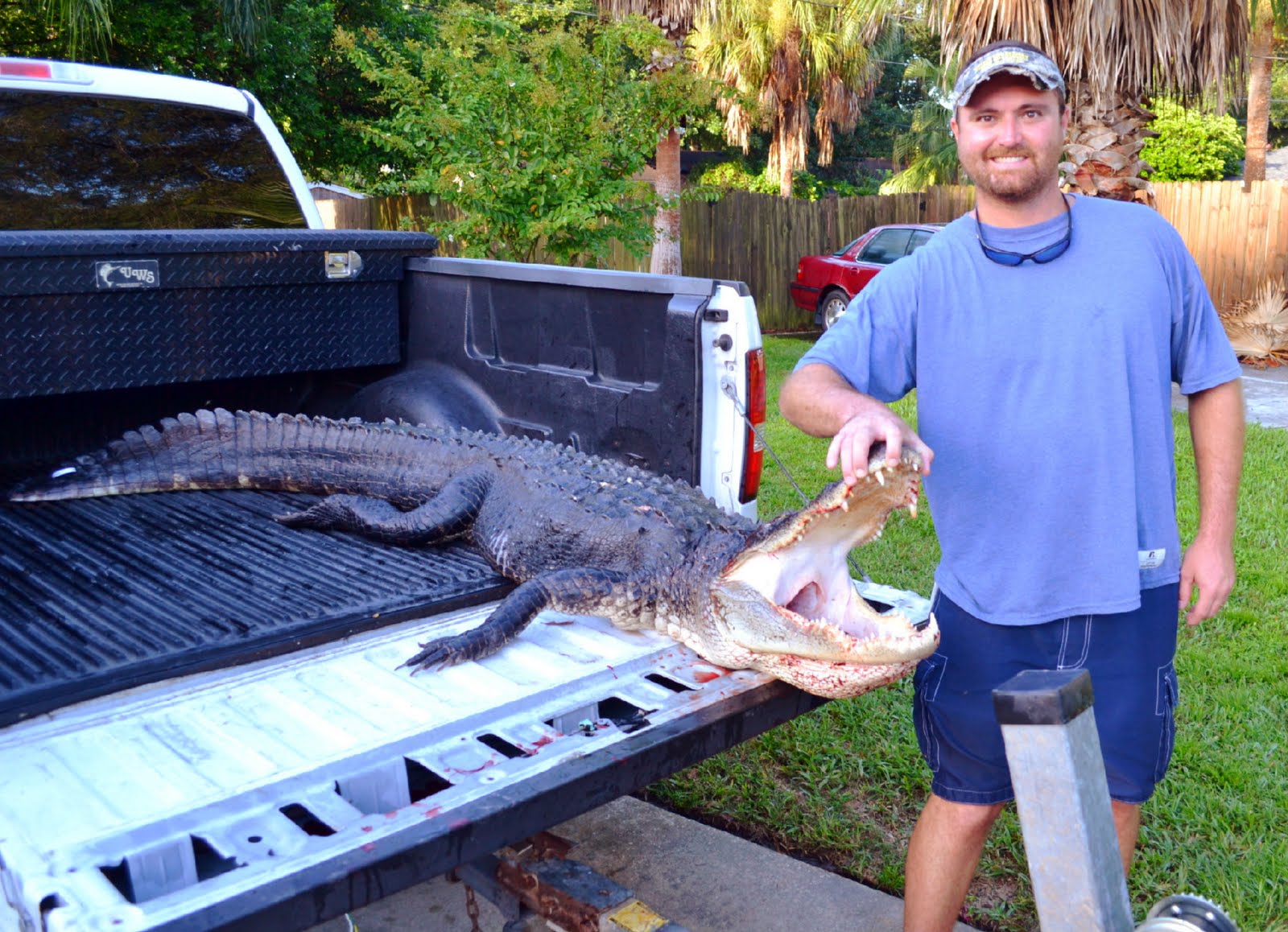
I have no way of saying what had happened. It might have been another gator that ripped into him or perhaps he caught a prop one day. Heck, the jaw could have been an old bite wound or something from when he was 8-inches long. And while I also can’t explain how he could eat with this malformation, the gator was able to endure – after all, he later taped at 9-feet 9-inches. But, he wasn’t surviving the bangstick to the dome, which leads me to the only reasonable conclusion – this was a zombie gator.
After dispatching the monstrosity, we wondered what we should do. No one really wanted to grab him, and we weren’t real sure how to tape his mouth. Still, we pressed forward, taping what could be taped of his jaws and hauling his stinking, mud-caked body aboard.
So, it wasn’t the biggest of gators but without question one of the most unique. I’ll have the skull European mounted – it should be an interesting conversation piece.
I just won’t keep it around the breakfast table.


Monday, September 10, 2012

Gators, Maybe?


With the onset of a low-grade migraine, I sprawled out helpless in bed Sunday afternoon watching what football I could capture through the one eye that didn’t burn from ambient lighting. Assessing a new NFL season, I couldn’t believe how poorly the replacement officials performed. During the 49’er – Packer tilt, I felt confident a special-teams player or assistant coach would take one for the team and kill a ref. Both of these squads were juggernauts last year and hope to recapture that glory in 2012. So much has to go right in today’s football to maintain success that any interference of unseen forces is detrimental to clubs. In addition to all the preparation, practice and acquisition of talent, praying for a lack of injuries and a weak strength of schedule - and playing outside of Cleveland or Detroit - is about all a team can do within their capability to challenge the Universe and punch a ticket to the playoffs.

Hunting is much the same way. A lot of things have to go right year in and year out to consistently tag whatever critter you’re chasing. Take deer. There was a four-year stretch where I could do no wrong. I could have constructed a small gazebo from the whitetail antler I killed during that time. I sensed I had it all figured out. Since then, I’m entering my fourth straight season without having had a reasonable whisper of connecting on even a spike.

Not to dole out too many frowny faces, but weather, work, time, Mother Nature's fickle personality, family and friends selfishly marrying during the fall, and changes in hunting locales have all conspired against me. I’m not complaining, but it's the truth. Though I've spent a reckless amount of time in the woods, it hasn't been enough to overcome the time I've not been there in order to succeed. And in all honesty, I compromised myself by half-abandoning the Antler Chase to free up time and resources forother ventures, namely ducks and gators. After three straight seasons of relative easy gator grabbing, I wasn’t prepared for them to Shanghai me this summer, but Shanghai me they have.

Gators deserve a lot more credit than they receive. The reality shows have served as a catalyst to get people interested in the sport. And – in contradiction to most ads – it’s not what’s seen on TV. Alligators are difficult quarry to describe. I wouldn’t exactly call them intelligent, but they are very wary, especially on hard-hunted lakes. They display a reaction to hunting pressure just the same as any other pursued beast. You can spot one across a lake, motor to him as he submerges and thenwait him out. Sometimes it works; sometimes he…well, we call it, “Transports to Dimension X.”

My first two mornings out on Harris’ 1st phase permits taught the ying and yang of their personalities. The opening morning you couldn’t shine or glass 50 yards in any direction without spotting eyes. Not all of them were behemoths, but seeing game is seeing game. Harris hooked into a large gator that was creeping along the bottom surfacing a trail of bubbles, a common tactic for snatching a gator. I put another treble hook into him and the fight was on. He breached the water once. From the brief showing, we could tell he was easily in the 10-11 foot range.

Somehow, though, he managed to pitch both lines. We reeled in the hooks and quickly fired them back out at his new trail of bubbles streaming from the bottom as if a regulator had popped out of the mouth of a Scuba diver. I felt the line go taunt and heaved into the creature, hoping to set the barbs deeper this time. We maneuvered over top of him as I could feel my line shaking, knowing I had hooked into something living and not a log or submerged car.

Slowly but surely, I hoisted up a trot line placed by one of the many commercial fisherman on the lake, hooks complete with catfish. The gator got away due to the interference. The following morning was a gator ghost town. Where we’d seen dozens the day before, now they’d vanished. The majority of gator hunting is done during the evening hours and two nights of boats had properly alarmed them.

After that showing it’s been a comedy of errors. A couple breezy days that caused the lake to chop. A failing spotlight. A sick child. Tropical Storm Issac. Prior weekend obligations. Work. I thought we’d had a monster pegged on Lake Buffum for a Saturday hunt on my tags – after weeks of keeping watch, he was nowhere to be found when the time came to collect. These are the elements of most failed seasons.
Harris, Belle, and Krunk with a 10-footer


The real kicker, though, is the crew I hunt with has persevered through these obstacles and landed fine gators. Harris and Krunk tagged two 10-footers in consecutive trips after I had been unavailable for the hunt. That’ll drive anyone nuts.

The nice thing is there’s still plenty of time in the season. Between us we have six permits and a month-and-a-half left to use them. After the 4th phase ends Wednesday morning, at 5 pm on the 12th, anyone with leftover CITES permits may return to their respective lakes and double their efforts. This 2012 general season will conclude at 10 am on November 1st.

As with hunting and football, you have to keep trotting out there, make the most of your chances, and believe things will break your way over the course of a long season – even if the year was not the one you were expecting.

Wednesday, June 6, 2012

Adjusting Florida's Gator Hunting Application System


Some folks want to blame Swamp People, but I think things were trending this way anyhow. Florida Gator Hunting has really jumped in popularity over the last five years. The hunts are exciting. They don’t interfere with other hunting pursuits. And up until recently, they’ve been pretty accessible. Now the FWC may have a burgeoning gator problem on their hands. Not one where they have to remove a reptile from a pool or dislodge a poodle from a gator’s gums, but with their hunting program.

Perception is reality to a mob. After the 1st round of drawings went down a few weeks ago, you could hear the torches flaring and the grinding of honed pitchfork tines. All kinds of wild accusations were flying about from the unsuccessful, from accusing the FWC of favoring non-resident applicants because they pay more for their permit - $1022 to $272 for residents – to suggesting gator guides are gaming the system by submitting applications for all friends and family members fit for a late-night gator chase. 

Indeed these are pretty reckless claims without proof. And this year has been tougher because demand has increased while the number of tags was diminished because of drought conditions. Anecdotal evidence an effective argument does not make, but I do have frustrated friends who have not been drawn in years of applying, and I suspect others do, as well. If these folks are applying for tough-to-draw lakes and zones year-in, year-out, then reason stands that the odds are never in their favor.

My method of applying is about the same as the NFL Draft. Everyone gets five picks per application – I try to apply for the top-shelf talent first and second. The third and fourth picks are reserved for bigger lakes with more tags, and the final is left for the less desirable licenses, like my fourth-season Polk County tag I paid for the other day.

But a few changes could really help assuage much of the clamor associated with this process and give everyone - well, almost everyone - a better shot at yanking a prized permit.

1. Institute a preference point system. I’d like to see points awarded to unsuccessful applicants weighted on whether, let’s just say, a person struck out on their first 3 picks. Assign 3 preference points for the 1st pick, 2 for a second pick, and 1 for a third rounder. Over time this will allow folks to eventually pull that coveted pond nearby with only two permits. They already use preference points for other quota hunts in the state – it couldn’t be that difficult to get it going for gators.

2. Designate a certain number of tags for residents and non-residents. As it stands now, I have the same odds of drawing a permit for a local lake as someone from Arkansas does. Nothing against non-residents and no xenophobia here, but there’s a real problem when Florida residents can’t access a local resource because of out-of-towners, even if this is only an imagined problem. This model is used in many areas in the West for desirable big game tags, and there’s no reason it shouldn’t be employed here. Maybe split the privilege 70/30 in favor of residents.

3. Adjust the Phase II application time. Not everyone was excited about going to a random draw system a few years back, but it was a relic. They continue to operate under a 1st-come, 1st-serve design for Round 2, but it starts at 10:00 am. Now, I paid for my tag so I’m ineligible anyhow, but I can tell you exactly where I’m gonna be at ten tomorrow – work. Maybe move it up to 6pm or so.

Look, it’s never going to be perfect, but the FWC does a pretty good job of listening to stakeholders and making sure all available permits are divvied amongst the crowd. Not everyone will draw a tag, and, believe it or not, gators are a limited resource. This is not an extermination program, rather a recreational one.

Gator hunting is great sport; there just needs to be a few wrinkles ironed out in the application process. But, hey, even if you don’t get pulled, you can always buy a trapper’s agent tag and participate in a hunt in which someone else drew the CITES tags and right to pay the 300 bones.

Or a $1000…*%&@! Out-of-Towners.

(Ideas? Suggestions? Let's hear it!)

Friday, November 11, 2011

The Gator Mount


Never figured to be in the market for an alligator head - mostly because, until recently, I never appreciated the trophy value of such an item. If so desired, they are easy to purchase from just about any South Florida truck stop or curio store. It’s like with bobwhite. If I want a mounted quail, I’ll buy the table with a covey under glass from Cabelas and be done with it. A gator head is a gator head. Big deal.

Well, that was dumb thinking. Taxidermy is about preserving memories, and that trophy gator from August was quite the experience. Still, even with the gator boated, I had no illusions of a mount. That decision was aroused out of desperation.

See, I cleaned that gator myself without benefit of a hoist, fork lift, or walk-in cooler. The other hunters had to be at work, and since I held the tag, it was my burden to bear. Think about this before setting off after your own leviathan. The intelligent option was to take it to a processor, but being cheap as the day is long, this wasn’t an appealing option. Plus, I figured I could handle it on my own.

Problem was – and I hadn’t really thought it through beforehand – that gator wasn’t coming out of that boat after the three of us had miraculously rolled him in. I’d have to carve it where it sat. So, I towed gator and vessel out to my folks’ place. Since they live on a few acres out of town, I figured I’d come up with an idea of what to do with it there. Plus, I needed Mom to take pictures.

Since this is a family website, I’ll spare the disgusting details of dressing a stinky 600-pound monster in the August heat. It was an ordeal. After I’d cooler-ed the tail, I was left with this immovable gator carcass and nowhere to go with it. Mom and Dad have a bass pond in the front, but – well, they still have to live there, and if it floated up...yikes. I wasn't about to sweat further burying it. Their property borders Lakeland Highlands Scrub Preserve; I could pitch it over the fence. All ideas were muted anyhow by that pesky problem of getting it out of the boat – lift with the knees, Mom! No, I’d need a team of oxen and a system of ropes and pulleys for these tasks.

Maybe it was the onset of heat stroke, but an idea germinated. The time had arrived to push frugalness aside; I may have to buy my way out of this mess. Let me call the taxidermist. Maybe he’ll have a place to dump the body if I agree to have the head mounted.

I dialed up George Norwood in Plant City to see if he taxidermized alligators. He quoted me $11 an inch. I asked how much of the gator he required. He replied to just bring what I wanted mounted. I asked again, and he picked up on what I was intimating. George laughed and said he’d charge more to dispose the mess than mount the head.

Long story short, I ended up finding a place to unload the gator – it took three of us risking serious hernias, Mom included, to roll the gator back out of the boat and down into a sand pit on private land. But on the ride out there I was calculating and rationalizing.

That’s not a bad price. It IS a trophy animal. Who knows when I may draw a tag again or find an animal that size?

I froze the head – cut off behind the jowls for that extra size effect - and the next day took off to Mr. Norwood’s. I didn’t have anything particular in mind. I knew I didn’t want any teeth replaced. Several of the front ones were chipped and broken like the smile of an old bulldog. Also the eyes. Poor eye color or setting devastates a mount, to me. A lot of gator mounts have these lime-green eyes like they’d been swimming near a nuke plant. I wanted something darker and more sinister. Beyond that, the bangstick hole would have to be patched.

I was surprised to get the phone call last week that the project was completed - with deer season not yet in full swing, he had plenty of time to work on it. I’m very pleased. The hide along the jaws is pretty firmly attached. It’s not like caping a deer where you can easily skin it off and tan. The whole head had to be submerged in a foul-smelling pickling solution. Before this, Mr. Norwood had to cut out as much meat in the jowls as possible. Once it was removed from the pickling solution and dried, insulation was packed into the back of the head and secured with wooden slats. This was then sealed with a black epoxy compound.

Anyway, the mount looks great. My only regret is I didn’t have more of it mounted. The head is certainly impressive, but that alone doesn’t represent the girth of the animal. That’s gonna have to remain a memory.

So it is now proudly displayed in the kitchen, lording over the pantry and scaring the bejesus out of the unaware who come in the side door. Couldn’t be happier. Everyday I walk in and stare at the beast and remember what a great hunt that was.

Wednesday, October 26, 2011

Thoughts on Florida's Alligator Hunting Season

I’m still gushing to folks about the trophy gator we killed in August. What an experience! Three years ago I could barely care about gator hunting. Now, it’s a must-hunt event, provided someone has the tags. In two of the three seasons I’ve applied, I’ve drawn, which totally helps the mood, too.

There’s still plenty for me to learn and hunting methods to try. I'm happy to have acquired the gear. Makes finding a boat ride easier. And any gator capture is a thrilling adventure. Just saying.

For those who have not filled all their tags, November 1st marks the end of the 2011 Florida Alligator Season. Just some thoughts from what I’ve learned and enjoy about gator hunting...

- The Mother-types in your life may rile into a dinner table kerfuffle, but gator hunting is a pretty safe activity. The things one may worry about like losing hands or blowing a foot off with a bangstick just don’t seem to happen very often. I really can’t recall any stories like this, and trust me, if it happened, it’d be all over the news. Spring time headlines in Florida are largely reserved for when a lizard chomps a toy poodle off a leash or when a crackhead takes a midnight skinny dip in the local lake and gets bit. There’s a primeval, instinctual fear of these things that forces hunters to comport themselves in a manner befitting the risks. The real danger rests in navigating waters at night, especially in airboats. But, again, accidents are a rare occurrence. Thankfully. Bring this up next time the hens start clucking.

- These are routinely successful hunts. From what I hear, most people who eat tag soup do so from a lack of time on the water. You know, it rains here in the summer. A lot. And there’s plenty o’lighting. This ruins quick trips, as you can imagine. Plus, Life gets in the way between the time you buy tags and when the season starts. Overall, if you put your time in, you’ll see plenty of game, and if your expectations don’t trend towards gaffing a monster, you have an outstanding chance at bagging gator tail. Can’t really say the same about other game species.

- If you do tag that Legendary Lizard, you have one heckuva trophy. Outside of hunting friends and family, generally no one gives a crap if I bag a nice buck or gobbler. Not so with alligators. Friends of friends and acquaintances ask to see photos of the bruiser we subdued this year. I can’t wait to get the head mount back.

- It's not Swamp People. Curse that show, for that's all people ask when asking about my hunts. We cannot hang baits from trees and shoot them with .22's. And I'm not sad about that.

- I don’t have a yearning desire to traverse the state hunting foreign waters for The One. For those targeting him, though, every year the biggest gators tend to come from the bigger waterways in the state like the St. Johns and Kissimmee. This isn’t to say there aren’t plenty Big Boys in other lakes throughout the state – there are – but these places really pop up in conversations about those that hang from front-end loaders and dwarf the accomplished hunter. If I were to come from out of state, I’d look hard at these places.

- I like morning hunting more than after dark. I can’t say if it’s easier or more successful, but it plays better with the sleep and work schedules. I will attest nighttime hunts are far more exciting, though.

- Like the futility in wishing for $1.50 gasoline, it’d be nice if the FWC came off the cost of tags. It’s about three hundos when all’s paid for – fifty bones for a trapper’s license to even help with the hunt. Though opportunities abound to tag out, it falls just barely within that thin line of good value.

- Having said that, FWC is banking. The popularity of deer hunting is declining a bit in these parts; alligator hunting is trending up – this is probably because the ease of availability, if you get past the cost. This, of course, reduces the individual’s odds of drawing a tag, but it’s nice to see people excited about the sport. Hunting recruitment is ever-important.

- The old trophy hunting adage, “The big ones look big” certainly applies here. You can easily talk yourself into believing a mid-size 9-footer is a stud. Then you see a stud and it changes your opinion of things. Generally, they are craftier and harder to hunt. What’s nice, too, is there’s nothing at all wrong with going after that 9-footer.

- I like the versatility of the hunting tactics. It’s great conversation fodder. We snag ours. Some buddies harpooned their limits by running up on surfaced gators and aiming at bubbles stirred off the bottom when they submerged. And another gentleman I know popped a giant with a bow and arrow attached to line and float. Certainly, different bodies of water dictate different strategies, but you can pick and learn from numerous approaches.

- I love my bangstick.

- These are simply fun hunts. It may not require, per se, a whole crew of friends, but it is better in their company. I’ve compared it before to offshore tournament fishing – everyone has to have a role when the action starts. In the downtime, there’s plenty of slack for the camaraderie. If you’re one of those who require your fingerprints alone to be on every instrument of destruction, I doubt we’ll hunt together. And I don’t understand why you’d want that anyway.

Tuesday, August 30, 2011

The Trophy Gator


“Never insult an alligator until after you have crossed the river.” – Cordell Hull

Down in a cove on the southwest corner of the lake, the gator moseyed towards shore. A beast, we didn’t figure we could cut him off with the trolling motor. But the surface drive would have definitely spooked him. We had to try – this gator had given us the slip on a couple other occasions, and the situation had grown personal.

Luck appeared to be in our favor. He ceased swimming and bathed in the open. Still, a gator this size could make it to weeds and cattails along the bank in a handful of tails swishes. I manned the motor, hoping to maneuver into a position where we’d block him from reaching the lakeshore where he’d be safe from snatch hooks. At least if he sank in the open, we could seek out his bubble trail. But, the best scenario was for him to stay surfaced - just had to get close enough to pitch the large treble hook.

We reached the brink of range as the gator started feeling the pressure and slowly resumed his cruise towards land, his gnarly head poking above the lake’s horizon leaving an inverted V of a wake to mark his trail. Cole was given the go ahead. This was no fire-for-effect situation – the gator would surely spook once the hook hit the water. It was just a matter of getting the hook and line over his back, reeling quickly and digging a prong deep into his hide.

Cole’s attempt had the distance of a worthy try, but not the accuracy. The three-pronged snatch plopped in front of the gator, missing by several feet. A tannic-stained wave of water erupted as he beat his tail and disappeared once again into the depths of the mucky lake.

Trophy animals – regardless of species – attain their status through the years. A trophy alligator, especially, is a worthy prize. One, they live for decades, surviving numerous assaults like the one described above, to say nothing of the violent relationships with other gators and predators in their youth. I would not depict them as crafty, as one would call a big buck whitetail, but they are certainly of a different mindset than their younger counterparts. Bull gators are often all too visible on lakes and rivers but have the capability to vanish in surprisingly shallow depths, the normal tricks plied to dig out the younger guys rendered ineffective.

And, like other trophies, a combination of hunter effort must usually overlap with an environmental or physiological change that exposes vulnerability in the animal. Take whitetails again. While a great many big bucks are taken outside of the rut, the majority are laid low when they shrug off their normal wary instinct to chase does. The problem with gators is the hunting season does not coincide with their breeding cycle. We desperately needed such an event to get the drop on this bad boy or we’d spend more time in fruitless pursuit, educating him even further.

We returned to the lake the next morning. I had drawn second phase tags for a popular Central Florida lake. By this point in the season, no doubt, the gator, and his hunted brethren, had endured a pestilence of hunters. A trophy specimen mixed with intense hunting activity only distances the odds of triumph. But he was firmly implanted in our minds. I’d never taken a truly large gator and was only lukewarm about taking a meat gator. This morning was sloppy, though. Winds coming from the advancing Hurricane Irene created a chop across the lake, making it awfully difficult to spot heads on the surface. It appeared that a repeat shot at this guy was slim to none.

So, Harris drove us across the lake - opposite the haunt of our villain - to hunt along a shoreline protected from the wind. Wimpy gators – 5-7-footers – popped up and down, but none were of any interest. Then I spotted a barge of a lizard floating in the middle of the lake.

Trophy judging gators is difficult. There are a whole lot of medium-sized reptiles out there that are 8-9 feet long that are big by reasonable standards and represent fine catches, but are not the leviathans of nightmares and campfire stories. And I know hunters probably help gators grow a few feet, too, when carrying a warm tag in their pocket as the nights drag on and on.

But, as the saying goes in trophy hunting, the big ones look big, and this one was a warhorse. This gator displayed his veteran status, as well. He submerged before we got close enough to even think about picking up a rod. I helmed the trolling motor until we neared where he went down and sat back to wait for him to show himself, careful not to kick gear around the boat and create startling noises and vibrations.

Thirty minutes passed and nothing. Good ideas were fleeting, with little hunting time left. We decided to circle the lake in hopes of spotting any action, but the waves thwarted us.

As we started back to the ramp the wind mercifully eased. We noticed an abundance of dead shad floating on the surface. The evening before, a huge thunderstorm dumped several inches of rain on the area. The influx of cool rainwater sank to the bottom of the lake releasing decomposing vegetation that removed dissolved oxygen from the water. Unable to breathe, the fish suffocated. Shad are particularly vulnerable to this in the shallows. We noticed one runt gator on the surface enjoying this feast.

That’s when I noticed our Man back in the cove where he had given us the slip the day before. He was surrounded by dead shad.

This time he allowed us to get fairly close before sounding just out of casting range. But unlike before, he surfaced quickly, hanging in that general area and not beating tail to shore. The shad buffet kept his attention fixed. His vulnerability was exposed.

This didn’t mean he was completely off his grind. The gator went back down as the anchor was lowered. We got a bead on where he was and prepared to wait him out, hearts absolutely racing. When he did resurface ten minutes later, he was off our port side and quickly sank after a quick breath. The gator wasn’t any closer to shore, but given any more time, it was a cinch he could make it there, no sweat. The decision was made to do a little prospecting with the snatch lines.

The gator betrayed no bubbles or other sign, but the snatch hooks were tossed with educated guesses. It was a long shot, but our only hope at this juncture. Time and opportunities were burning. Harris hung something on his third or fourth cast. Near a shoreline with cypress and oaks, it was a safe bet he’d hooked a large, waterlogged treetrunk. Indeed, it was coming up far too easy. We stood on the bow of the boat peering into the muddy water, hoping it was gator.

That warty head surfacing at our toes is a moment that cannot be forgotten. We all jumped back startled and scrambled to find gear with sharp points attached. Those yellow eyes, set so far apart, glanced up over us briefly before thrashing into a tug of war. I grabbed my new rod rigged with triple treble hooks and frantically tried to set another line to him as Harris tried to keep tension on the gator without snapping the line or rod. A gator that size would not be real impressed with one angler, and his thick skin could easily toss the hook. After several attempts – nearly fouling the original line more than once – I struck hide.

The old boy made several runs – not the high spirited streaks younger gators will do; just a constant freight train charge. A harpoon line was a necessity to try to gain control over him as our drags moaned, reluctantly giving up line. He could easily have pulled us into the debris around shore, or that powerful tail could rub through the braided with his scaly hide. I handed my rod off and prepared the harpoon. Finally, enough line was retrieved and a few pumps on the rods brought the gator towards the surface along the portside gunnel. I tried twice to sink the point into whatever leather I could hit but without success. Eventually, I drove the harpoon head in his massive tail, not the ideal spot, but it was what I could do.

I prepared another harpoon line when the gator rolled. The harpoon point and all hooks came loose and he was free. Harris immediately grabbed another rod and began pitching it at the gator, who realized he had an opportunity to reach safety but seemed discombobulated by the action. He whirled close to shore as I rushed to untangle the other lines. Finally, Harris – this hunt would have failed without him – hooked up.

Again, we couldn’t be sure it wasn’t a tree. Harris was unable to budge him. I went ahead and snagged whatever it was with another line and reeled. The line came tight and rod bent over to the water. Whatever it was wasn’t budging.

Thoughts of failure crept in. Almost certainly we were fighting a cypress stump. The object gave no ground. It was like trying to pull a screw straight out of a bolt without turning lefty-loosey first. We kept the pressure on, though. My back began aching and my arms shook from fatigue, sweat blurred my eyes. After what seemed like an hour – but more like 5 or 10 minutes – I felt a quiver on my line and knew we had him again.

He didn’t fight like he had before. The gator was clearly exhausted. Harris and I decided to go ahead and heave him to the surface. That wide, landing strip of a back, resembling tank tread but constructed of blown semi-truck tire, peaked out of the water before rolling over and displaying a dark yellowish underside flecked with scars, leeches and mottled patches of hide.

This time, we put two harpoons in relatively easy despite our remaining reserves of collective strength hovering in the red. The fight had led us into the cattails and aquatic plants along shore, but with four lines in him now, Harris used the trolling motor to free us from this tangle and tried to use the momentum of the boat to bring his head up for the bangstick.

It worked but only briefly. I failed on my first chance, his dome rising and falling without a shot. The anxiety had built to a head; I could not afford to let another attempt slip by. Over the course of several hunts and by the grace of good fortune, he was right where we needed him. But it was not over yet - a gator that size wouldn’t require much more than a solid breath or two and the fight in him would return. I was not confident how much further our luck would stretch.

My first shot was a touch off-center. The gator quickly dove and thrashed. I reloaded. Again, Harris pulled him onto a plane, and I quickly tapped another .44 in his skull. The struggle slacked. The trick now was to get him onshore without losing him. There was no way to get him in the boat on open water.

Harris held the harpoon lines and trolled the short distance back to the ramp. The huge gator was all but expired as we rolled onto the mud. I carefully crawled out of the boat, trying to avoid his tail - if he was to thrash, he’d snap my legs - and put another shot in the sweet spot. It was then we knew it was all over and the celebration began.

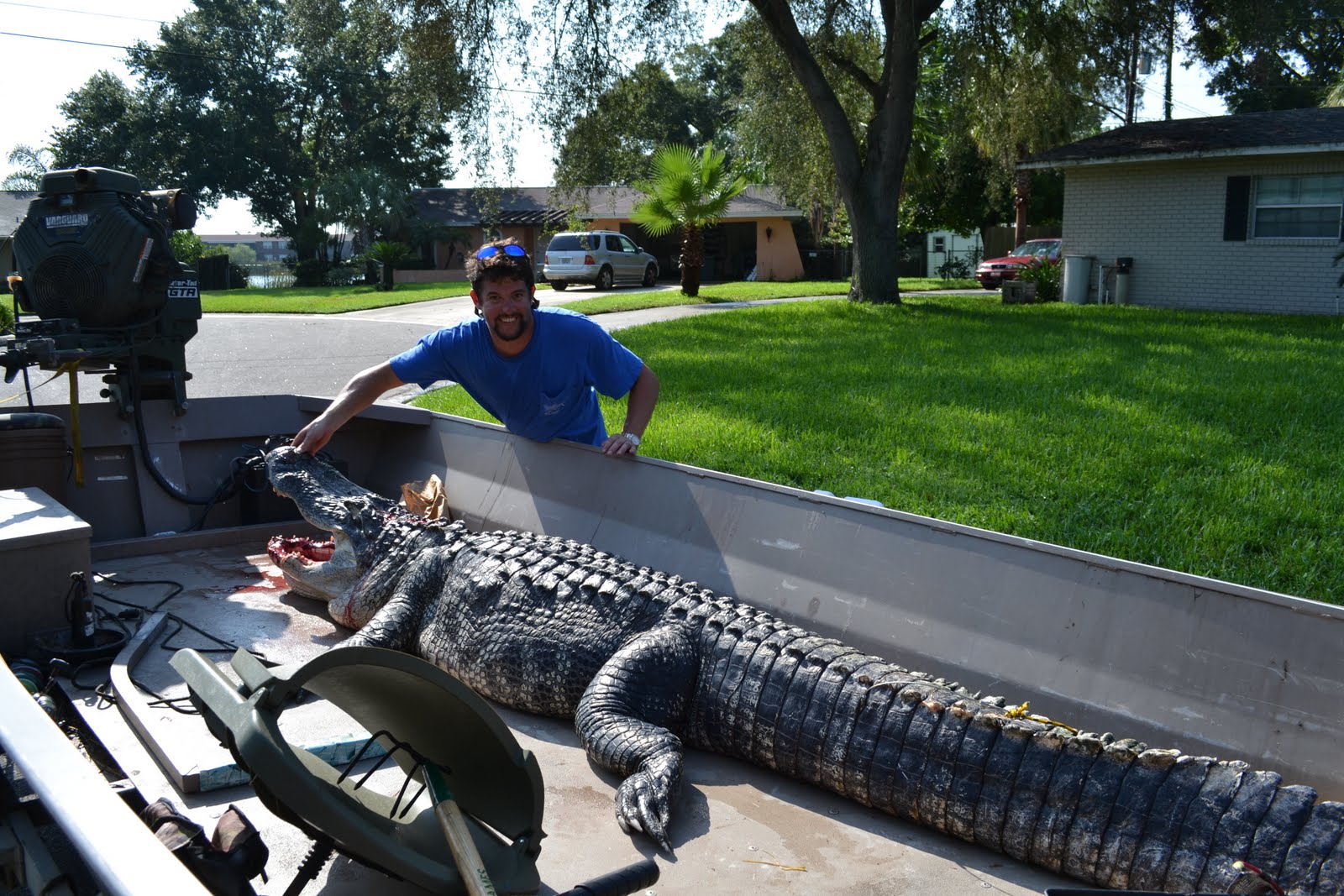
The alligator was a real monster. I’m not sure how we rolled him in the boat, but the gravity of what we had done finally hit us. We knew he was big but not like this. The gator taped 10 feet 8 inches. More impressive than the length was the girth. He was a massive bull with the fattest jowls I have seen on an alligator. His claws resembled those of a grizzly, and his hide was scarred from years of fighting the nature of Central Florida. I loathe making such assertions without the proper instruments, but I’m guessing he weighed somewhere in the 600-700 pound range.

As I said, taking a trophy animal is something special. It requires effort and luck and unforeseeable circumstances to help bring one to bag. On an animal like this, you feel the accomplishment from the congratulations of friends to the soreness in your back and arms, and the adrenaline that lingers through the rest of the week. And I’d be severely remiss if I did not give Harris his due; he guided the trip and hooked the gator. It’s as much his prize as mine, if not more so. I just happened to pull the tag and fire a few shots.

Though I am still a novice in the gator hunting ranks, it is safe to say, trophy-wise, years will pass before this Old Boy is matched. And if Time offers up no adequate comparisons, that will be fine, too.

This experience could never be topped.


Sunday, August 28, 2011

Thoughts on a Nine Foot Gator


For us at least, gator hunting is a team sport. True, one person draws the tags and has the claim on the trophy, but there is a lot going on when a gator is spotted and hooked. It behooves the tag-holder to enlist the aid of licensed helpers.

Plus, it’s fun with a crowd. Alligator hunting is exciting and best shared in the company of friends. And when you get a crew together who has the hunting experience and knows each other well enough to handle a pressure situation, the results are impressive.

I don’t mean to brag, but we flat whipped a nine-footer a couple Friday’s ago. Harris had the tags for the first phase. The previous Wednesday he and another group bagged a 10-plus trophy, and I was kicking myself for scheduling work appointments so early in the morning. Friday I did not miss the invite to help punch his second tag.

As I have described previously, our manner of hunting gators relies on spotting the target and getting within range of casting a large treble hook to snag the reptile. Then we put another fishing line in it, harpoon and then bangstick. It’s not all that easy, though.

One, the gators get spooky, especially on lakes with a large number of tags. Gators are easy to spot but approaching them is the tricky part. If you get lucky, they will stay close to the surface, and you can lay a line across their backs. If they submerge before you are in range, you approach quietly by trolling motor and look for bubble trails from where the scoot across the bottom, stirring up the muck. Still other gators will go down and not move, and the goal is to wait them out and hope they surface for a breath nearby.

The first gator we moved on that morning gave us the slip. We had spied him from afar. As we approached, he submerged, but left a solid bubble trail. The problem was, he was moving quick, and we tried to keep pace with the trolling motor – as much as a high-speed chase as you can get in this situation. The hooks were missing their mark. The gator whirled around under the boat anxiety and we lost track of him. We finally picked back up on a bubble trail and watched as a small 5-6 footer surfaced. I guess we scared him up while pursuing the bigger one. He had Houdini-ed us.

I glassed a very large gator across the lake, so we cranked up and made way to his location. While in route, the gator sounded, but we quickly spied another lizard that piqued our curiosity. Harris elected to spend his final tag on him, and after locating his bubble trail, the fight was on.

Getting the second fishing line into the gator is usually the most anxious component of this experience. You have to be very careful not to tangle the other line and pull it loose, and even though you have a general idea of where the gator is, the water depth and the way the animal is swimming or laying on the bottom affect a quick hook-up. On a crowded boat and the intensity of trying to double up lines, confusion can set in and tempers flare.

Someone got the second line into this gator with relative ease. He was hauled to the surface – an angry alligator is the most PO’ed animal I’ve ever seen. I tagged him behind the head with the harpoon and the spinning Death Roll commenced, splashing water over us all and banging against the side of the boat. This guy was beefier that we had thought.

The real problem then came with the position of all three lines. As Harris readied the bangstick, I held the harpoon line while Cole held the two fishing rods, both hooks also stuck behind the noggin. When we’d raise him, he’d surface head-up giving him extra momentum if the spirit moved him to join us in the boat. And this guy could do damage.

This situation proved problematic for the bangstick. The gator was angled as such that a shot would travel through the skull and towards the hull. We needed to get him sideways instead of bobbing up and down in the water column. I tried to pull him up and troll him past Harris, but this put me in the way when the shot presented itself. Finally Cole grabbed the harpoon line from the bow and lifted. This different angle gave Harris a shot and he reached deep to pop the gator.

Harris made a great shot and the gator’s lights went out. We hoisted the gator alongside the boat, taped his mouth and rolled him aboard. All told, it didn’t take 15 minutes from hookup to finish. Probably less. Everyone worked well.

The gator taped at 8”10 with a couple inches missing from his tail – so fairly rounded up to an even nine feet. He was no monster, but a solid gator and the biggest one I had been a part of catching up to that point.

Most impressive was the efficiency in which we solved problems that presented throughout the course of the hunt. It’s an easy game to sensationalize. Between bangsticks and harpoons and snatch lines and toothy beasts, there is a high potential for dangerous incident. It’s important everyone figures out their roles quickly.

This makes gator hunting one of the most exhilarating outdoor sports in which to participate - whether you are making the kill or not.


Camo Dipped Alligator European Mount

I’m in the midst of a taxidermy binge. Which is great – it means high times afield. My bobcat is close to completion. I just hauled a bull gator to my man for a head mount (story still pending). These specimens were clear-cut trophies, and I am excited to put them on display.

But the mount I’ve most been looking forward to was delivered yesterday.

I am not a fan of altering trophies. I want them to represent the animal honestly and in as close a position to what it was doing when our paths crossed. Hogs, for example. A lot of boar mounts have their cutters pulled out to make them appear more ferocious. It’s a bogus memory. Likewise, I didn’t want my bobcat mounted on a limb with claws and teeth baring and coming off the wall like it was shot out of a cannon. I chose a style where he was in a semi-sneak, like he was pursuing the female cat with him. My wood duck is not in flight because I shot him off the water. Kidding.

To each his own, of course. I just like the memory and mount agreeing on the moment as much as possible. European mounts are different. It’s a skull. It’s a memory, but it’s difficult to evoke the same feelings as a pelt. The skull is cold.

Now, I do think they are awesome. I have several hogs and a couple deer done this way, and they fit well in my taxidermy display. And they are more hands-on figures. People can examine the hog skulls and mess with the teeth. It’s cool. When I saw Matthew Beck of Legacy Skull Preservation offering Alligator European mounts dipped in camo, I knew I had to have one.

If you have not read my interview with him from last month, please do so – or at least visit his site. He works very hard at preserving skulls. In April I took him a skull from my first gator season two years ago, an 8-foot female pulled from Lake Garfield after a week of hard hunting. I had done what every lazy person seems to do with these things – place it in an ant bed, sun bleach it, and tuck it in a closet until I could find the time to reassemble the teeth – which, let me tell you, picking through a fire ant bed trying to find them all is none too pleasant.

The skull had a chalky feeling to it. The lower jaw had splintered and the bone was separating by the nose. I applied glue to hold everything together. When I went to re-set the teeth, I realized I had no clue in the world where they all went. I took this mess to Matt, and he was kind enough to accept the project. It took a while for him to repair the damage I’d done trying to bleach the skull, but the finished product has been the joy of my week.


The camo pattern is called Boggy Vizion. The skull is sturdy and smooth to the touch. The white teeth really pop against the dark camo. I love it. My wife loves it. All God’s Children love it.

Next time I get a large gator I’m gonna have Matt mount it bone white. The camo really hides the work he put into this one. That would make three gator mounts, which is more than fine for my trophy room.

Check out Legacy Skull Preservation!

Monday, August 15, 2011

Basic Gator Hunting Gear and Strategies


This week I will be taking delivery on a new harpoon from Central Florida Trophy Hunts. Their combo package includes a stainless steel base, driver, two Muzzy harpoon points, 100 feet of rope and two Styrofoam buoys. For 120 bucks plus shipping, it ain’t too bad. Just gonna have to run to ACE to get a dowel to mount it on. Shy of a boat, this will complete my crusade for gator hunting gear. But once you have all the gear, boats are easy to come by.

For those of you raised on Swamp People who believe gator hunting is as easy as shooting a gator in the head with a .22 while it chokes on a hooked chicken thigh, know Florida does not allow the use of firearms. Nor baited hooks – baited pegs, yes.

To wit, there are numerous tactics hunters use to land gators, most of which are dependent on the elements of the Happy Hunting Grounds. Some folks, especially those who hunt shallow, weedy areas, prefer a run-and-gun style. They spotlight red eyes and floor it to that location and try to spear or arrow the gator. Or track their bubbles and pitch snatch lines provided the vegetation isn't so thick that it hangs hooks.

For some who hunt large rivers and open waters, using baited lines to chum gators is their preferred tactic. They are not allowed to set lines from shore – and catch those “Tree Shakers.” Baited lines must be hand-held or secured to a boat. Plus, no hooks may be used; only 2-inch wooden pegs wedged into the bait and thrown in the vicinity of a gator or in a likely location. Common baits are beef lung and rotten chicken and are pretty repulsive. The gator swallows the bait and the Tug-O-War begins until it is hit with snatch hooks or harpoons.

Still others take the silent approach, spotlighting gators from a distance and stalking within range with minimal light and by paddle or trolling motor. If the gator sounds, an anchor is eased over. Most times the gator will not travel far. When the gator is sighted again within range, the snatch line is cast over the beast and the fight is on. Hunters must be quiet not to kick equipment and beer cans around the vessel as this noise easily spooks the gators.

I cannot speak much more than this about baits and harpooning and bows and arrows; I’ve never tried these methods. We’ve relied on this final model, and it is the equipment needed for this that I would like to discuss.

Let’s start with lights. Q-Beams are near-essential tools for the gator hunter to spot game at long distances. Not surprisingly, different hunters disagree on how much a spotlight should be used; some feel if you keep it in their eyes, it keeps a lizard from submerging. Others feel you should douse the light and sneak in the dark. I agree with the latter camp only because I’ve not witnessed an effective execution of the former strategy.

But, you must still see where you are throwing. We use low wattage headlamps. It can be difficult for others in the boat to see the game, but for the person wearing the lamp about to cast a line, the light is just enough to shine those eyes.

Which brings us to the pitch rods. Last year Harris introduced a new strategy. On previous hunts with him, he used two stout rods with large treble hooks. The muscle was there, but the casting range was limited and inaccurate. Plus, large three-pointed hooks slinging out of the boat made everyone a little antsy. So, last year he decided to bring a smaller rod with lighter line that cast farther. We were hunting open water, more or less, so we could quickly maneuver close to put more lines in him without much fear of the gator breaking us off. Worked twice in the night.

Dad visited Bridgemaster Fishing Products in Lake Wales to find a gator set-up for my birthday. On the advice of a seasoned hunter, he bought a 7-foot E-Class Roddy Gator Tail with an Okuma Avenger and 150 yards of 80lb. Tuf-Line. The gentleman also recommended rigging a line with three treble hooks and a weight on the end. Previously we had just used a weighted hook, but I can see the benefits of adding a couple more. (I do fear my knot-tying skills for this operation. I’m usually surprised when I tie my shoe and don’t have a finger wrapped in the bow. It's why I wear sandals.) After a gator has been hooked, we try to put another line in him. It's important that people work together because lines will tangle and snap in the frenzy.

Once you’ve spotted a gator and put a line or three in him, the next step is the harpoon. Gators roll up and down lines like yo-yos when boat side. That harpoon line is insurance and makes the situation more manageable. The one I’ve purchased – and there are numerous companies that sell them – is a straightforward design. A harpoon tip is rigged to rope and a float. This is then placed on a driver. The hunter leans into a strong jab to get under that tough hide. The tip comes off the pole and the floats are free to go overboard if the gator takes off. Now comes the dangerous part - getting the gator boatside and subdued.

I’ve written about my bangstick before, so I won’t repeat myself today. The goal is to send the slug in a spot directly between the eyes and two to three inches behind and angled towards the brain for a humane kill. It must only be used when the gator is a few inches below the water and only when the gator is secured to a restraining line as described above.


This typically knocks the wind from their sails, but gators are dangerous critters with small brains. It’s prudent to wrap their snouts - very carefully - with electrical or duct tape. Then, sever the spine behind the skull. Their eyes should shut after giving up the ghost.

As I noted earlier, this is the basic manner in which I have gator hunted. And I will confess, I've never personally dealt with a true dinosaur. How each captain or guide or hunter performs is dependent on their experience, and I welcome any advice should one want to share it. Gator hunting, for us, has been a team sport and very enjoyable as long as everyone is on the same page.

One last thought if you’re the captain of the vessel. Make sure you have all your running lights, throw cushions, flares, and life jackets on board. The Man is relentless. A trapper’s agent license is required of all those who aid in the capture of a gator and can be purchased online and at the local Wal-Mart or sporting goods store.

(FYI: For this year, tags have been applied for and distributed. The first phase begins today. The new hunting hours are 5pm to 10am each day of the 11-week season)

Wednesday, July 6, 2011

Alligator European Mounts: Interview with Matthew Beck of Legacy Skull Preservation Inc.


In April I visited with Matthew Beck of Legacy Skull Preservation Inc. in Weeki Wachee, FL. Mr. Beck specializes in European Mounts. He grabbed my attention a month or so prior in a blog post that featured a gator skull dipped in a grassy camo pattern.

I was hooked.

Like most other semi-successful hunters, I have a collection of skulls just sort of sitting around the house like you’d find in a den of cavemen. They were bleached the good old fashion way – in the sun, sitting in an ant pile. As I’ve come to learn, this is horrible.

So I had a skull from a 7ft gator taken on a hunt a couple years back doing nothing but collecting dust, teeth fallen out and kept in a cup. After describing to Mr. Beck the condition of the skull, its numerous glue jobs and what I had done to achieve its chalky white glow, it took convincing for him to accept this challenge to clean and dip it in the pattern of my choice. Nonetheless, accept it he did, and I am breathlessly excited to have it back to put on display.

More than this, though, it was a wonderful experience meeting with Mr. Beck in his shop. His work is remarkable, as his passion for this craft. His mounts are elegant and would stand out in any trophy room. As you’re about to learn, preparing European mounts takes patience and a great deal of talent.

I asked him if he’d take time from his schedule to accommodate an interview, and he kindly accepted.

IN: What are your Gator Hunting Plans for this summer?

MB: Both my wife and I drew permits. I’m going with a friend, and we are going to try to pull two alligators using his Gheenoe. Hopefully this will give us the opportunity to get into some areas that we would have trouble getting to with a bigger boat.

My wife and I are going to take my 14 year old niece to get her first alligator. This is probably the hunt that I’m most excited about. I would rather watch a kid take their first gator than take one myself. I try to take one of the kids in the family every year.


IN: Tell everyone about that Monster you have mounted in your house?

MB: I took the “Monster” at an undisclosed location. He was a little over 11 feet long. He was missing nearly 2 foot of his tail. I’ve had many guides and professional trappers tell me that he is the gator of a lifetime. He was the first alligator I ever took. I have a shoulder mount of him in my living room, and I smile every time I look at it.

IN: With those giant gator heads in your shop, what keeps you from laughing in disgust at people such as me who bring you inferior-sized skulls that’d been bleached in the sun?

MB: I understand that more than preserving skulls, I am preserving memories. I have many large and interesting skulls. A few of my personal favorites are a skull from an eight-foot alligator that my son took when he was 11, a skull from an alligator that my wife took, and a special four-point whitetail that I shot.

I would like to think that I have seen it all, but every year I get something in that I can’t believe. When people bring me a skull that they have tried to clean and failed, I try to give them an honest assessment of what I think I can do with it. Often times I can “fix” the problem and give back to them a presentable product. If the skull has been boiled or harsh chemicals applied the chances of getting it to look “acceptable” are greatly diminished. I hate to have a skull leave me looking poorly.


IN: How long have you been working on European Mounts – as a hobby and professionally - and what got you started?

MB: I started cleaning skulls professionally four years ago. I have been doing it as a hobby for myself and, reluctantly, for friends for much longer. After cleaning my first alligator skull for a friend I decided to start Legacy Skull Preservation Inc. I cleaned his skull because at the time we had a hard time finding anyone that could do an acceptable job.

IN: Run us through the bare bones – ha! – process of treating a gator skull and what problems do you run into along the way? What is the typical time to complete one?

MB: The bare bones....skull humor!

Every skull is different but I will try to provide an overview. The first step is to remove all flesh, skin and tissue. Brain flushed out and excess flesh cut away. The skull is then ready for dermestid beetles or maceration.

Maceration is a bacterial bath that is maintained at an optimal temperature for the bacteria to break down and remove all flesh and tissue. This process takes 7 to 15 days.

The next step is to remove all grease. This is a process of time, temperature, and solution. The skulls are placed into a solution of cleaning agents and maintained at a constant temperature. The solution is changed frequently, sometimes as often as every day. This process can take 4 to 6 months depending on species, age, and condition of skull. The solution gently removes all grease and staining. It is a long, slow process but one that I find necessary to maintain the integrity of the bone and to keep delicate bone structures in place.

The next step is whitening. I use industrial strength Hydrogen Peroxide.

The final step is drying, articulating (gators tend to fall apart), gluing teeth back in and sealing with a museum grade sealant.


IN: What gave you the idea to dip skulls in camo paint?

MB: I can’t claim credit for it, but I don’t recall where I saw it first. It is becoming very popular. A skull that is dipped still needs to be thoroughly cleaned to insure that the film creates a permanent bond. At first I was not impressed with the idea of covering up my hard work as I take great pride in what I do. It was definitely something that had to grow on me. I will say that some of my favorite skulls are the ones dipped in camouflage that mimics an animal’s natural environment. An alligator dipped in the Boggy Vizon Marsh pattern is one of my favorites!

IN: What is the worst thing a client can do to a skull before he or she brings it to you?

MB: I certainly don’t want to give anyone any ideas. The best thing a customer can do is to follow the instructions of my website.

Treat the skull as if it were going to a traditional Taxidermist. The fresher the better - freeze it as soon as you can. Skulls left out to spoil stain and are difficult to get fully grease-free. Cut the head off well below the skull. I would rather have a little extra than have the back of the skull cut off. If they have any questions, give me a call - I will gladly walk them through the process so that they can get the best looking skull possible.


IN: How would you prefer a client to bring you a skull?

MB: My Website has directions on how to mail skulls directly to me. Please call before mailing. In some situations I’m able to pick up or meet a client in the Tampa Bay to help save them a little money.

IN: Since you are a professional chef, give us a gator recipe you enjoy.

MB: I’m still looking for the perfect recipe. My family enjoys it fried, ground and cooked on the grill.

Here are some general tips:
1. Ice down your Alligator as soon as possible, it is warm here and meat spoils quickly.
2. Clean and trim the meat thoroughly - remove all but the whitest meat.
3. Tenderize it all with a hand held needler or a fork.
4. Marinate in buttermilk or, our favorite, a little honey, orange juice and oil.
5. If you are frying, it is better to cut it into smaller pieces and cook quickly being careful not to overcook.
6. Ground gator can take the place of any ground beef just be aware that it is very lean.
7. An extra splash of Olive oil or ¼ stick of butter helps when you are cooking it.
8. Grill quickly and brush with extra marinate. Serve hot off the grill. Once it cools it loses all its charm.

Smaller pieces of alligator make a lovely Sesame “Chicken.” I make this without a recipe but will write it down. Next time I make it, I will share it with your readers. This will be a perfect excuse for you to invite me back.


Please visit Legacy Skull Preservation Inc. at www.Legacyskull.com. If you have any questions, feel free to e-mail Matthew at mbeck@legacyskull.com. In addition to alligators, Mr. Beck will also mount deer, hogs, wild sheep, and variety of other game species. He has a gallery of unique skulls for sale you certainly will want to check out.

With Gator Season starting in a month, successful hunters will want to know ways to commemorate a first-rate hunt and preserve an awesome trophy.

I strongly recommend they get in touch with Matthew Beck.